


Weathering and erosion are geological processes that act together to shape the surface of the Earth.
Erosion is displacement of solids (soil, mud, rock and other particles) usually by the agents of currents such as, wind, water, or ice by downward or down-slope movement in response to gravity or by living organisms.
Weathering is the decomposition of rocks, soils and their minerals through direct contact with the Earth's atmosphere.
Comparison chart
| Erosion | Weathering | |
|---|---|---|
| Definition | Erosion is displacement of solids (soil, mud, rock and other particles) usually by the agents of currents such as, wind, water, or ice | Weathering is the decomposition of rocks, soils and their minerals through direct contact with the Earth's atmosphere. |
| Types | 5 - Water,Ice,Wind,Gravity and Thermal | 3 - Physical, Chemical and Biological |
| Resultant | Small particles of rock, soil. | Small particles of rocks, soil |
| Movement | Movement of eroded material occurs | Movement of weathered material does not occur. |
| External causes | Wind, water, ice, humans etc. | Atmospheric conditions like air, pressure etc. |
| Gardens/Fields | Breakdown of the top soil causes change in health and growth of plants. | Wind, Rain, Water from garden hoses, freezing temperatures, etc. |
Factors
Erosion occurs because of factors like wind, water, ice, human activities like deforestation etc. Weathering, on the other hand is caused by contact with the earth's atmosphere. These atmospheric conditions may be heat, pressure etc.
Movement
Erosion is caused by the movement of eroding agents while in weathering there is no movement. Weathering is caused when rocks come in contact with atmospheric conditions but there is no movement involved of either of the components.
Types
Weathering is broadly categorized as follows:
Physical or Mechanical Weathering
Mechanical weathering is the cause of the disintegration of rocks. The primary process in mechanical weathering is abrasion - the process by which clasts and other particles are reduced in size. These can further be classified in the following:
- Thermal Expansion: Thermal expansion, also known as onion-skin weathering, exfoliation, insolation weathering or thermal shock, often occurs in areas, like deserts, where there is a large diurnal temperature range.
- Freeze Thaw Weathering: This type of weathering is common in mountain areas where the temperature is around freezing point. Frost induced weathering, although often attributed to the expansion of freezing water captured in cracks, is generally independent of the water-to-ice expansion.
- Frost Wedging: Frost action, sometimes known as ice crystal growth, ice wedging, frost wedging or freeze-thaw occurs when water in cracks and joints of rocks freezes and expands.
- Pressure Release: In pressure release, also known as unloading, overlying materials (not necessarily rocks) are removed (by erosion, or other processes), which causes underlying rocks to expand and fracture parallel to the surface.
- Hydraulic Action: This is when water (generally from powerful waves) rushes into cracks in the rockface rapidly. This traps a layer of air at the bottom of the crack, compressing it and weakening the rock.
- Salt crystal growth: Salt crystallization or otherwise known as Haloclasty causes disintegration of rocks when saline (see salinity) solutions seep into cracks and joints in the rocks and evaporate, leaving salt crystals behind.
- Biological Weathering: Living organisms may contribute to mechanical weathering.
Chemical Weathering
Chemical weathering involves the change in the composition of rocks, often leading to a 'break down' in its form. This type of weathering happens over a period of time. The types of Chemical weathering are:
- Dissolution: This occurs when rainfall is slightly acidic and gases in the air are added to it. This consequent mix can cause solution weathering of rocks.
- Hydration: Hydration is a form of chemical weathering that involves the rigid attachment of H+ and OH- ions to the atoms and molecules of a mineral.
- Hydrolysis: This is a chemical weathering process affecting Silicate minerals.
- is a chemical weathering process affecting Silicate minerals. In such reactions, pure water ionizes slightly and reacts with silicate minerals.
- Oxidation: This occurs within the chemical environment and makes the rocks soft.
- Biological: Biological weathering is when acidic chemicals are released by plants and animals.
- Carbonation: When carbon dioside is added to the rocks and minerals it may result in their dissolution.
Types of Erosion
The various types of erosion are:
- Gravity erosion: Due to gravitational forces, down slope movement of rocks results in their erosion.
- Water erosion: This is caused by the impact of rainfall on bare soil.
- Shoreline erosion: This occurs on both sheltered and exposed coasts through the action of sea waves.
- Ice erosion: This is caused by movement of ice or glaciers.
- Wind erosion: Wind erosion is the result of material movement by the wind.
Resultants
When a rock is weathered it gets broken down in to smaller particles but stays where it was. After erosion takes place, the resulting smaller particle is transported or moved to another place. Erosion may cause the rock to break down in smaller pieces than weathering.
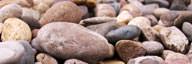 Rocks
Rocks  Stalactite
  Climate
  Abiotic
  Isthmus
  Hurricane
Comments: Erosion vs Weathering
Anonymous comments (2)