

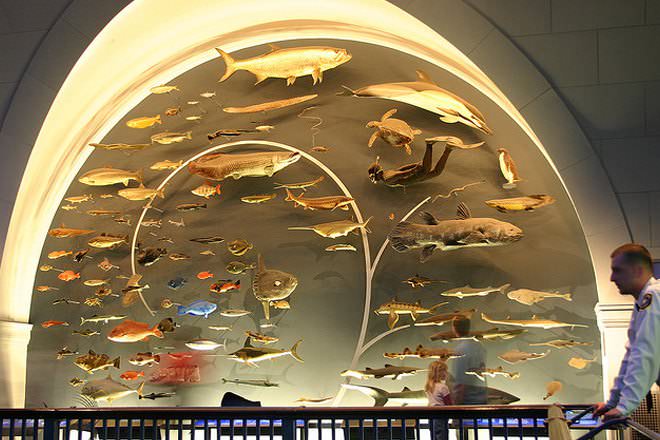
Animals can be classified into two main groups: vertebrates and invertebrates. The main difference between vertebrates and invertebrates is that invertebrates, like insects and flatworms, do not have a backbone or a spinal column. Examples of vertebrates include humans, birds, and snakes.
Comparison chart
| Invertebrate | Vertebrate | |
|---|---|---|
| About | Animals without a backbone | Animals with an internal skeleton made of bone are called vertebrates. |
| Kingdom | Animalia | Animalia |
| Physical Characteristics | Multicellular; no back bone; no cell walls; reproduce sexually; heterotrophic. | Well-developed internal skeleton; highly developed brain; have advanced nervous system; outer covering of protective cellular skin. |
| Examples | Insects, flatworms etc. | Parrots, Humans, snakes etc |
| Classification | 30 phyla | Classified into five groups: fish, amphibians, reptiles, birds, and mammals. |
| Phylum | Chordata | Chordata |
| Size | Small and slow moving. | Big in size. |
| Species | 98% of animal species are invertebrates. | 2% of the animal species are vertebrates. |
| Number of species | ~2 million named, many millions more not yet identified | 57,739 |
Differences in Physical Characteristics

Invertebrates have no backbone, while vertebrates have a well-developed internal skeleton of cartilage and bone and a highly developed brain that is enclosed by a skull. A nerve cord is enclosed by vertebrae — individual bones that make up a vertebrate's spine. Vertebrates have well-developed sensory organs, a respiratory system with either gills or lungs, and a bilateral symmetry with an advanced nervous system that further distinguishes them from invertebrates.
Vertebrates are divided into two groups: animals without jaws (Agnatha) and animals with jaws (Gnathostomata). While most vertebrates can move and are heterotrophic (i.e., cannot make their own food), some invertebrates may be able to make their own food.
Due to lack of a supportive system, a majority of invertebrates are small. Invertebrates have two basic body plans: one is the radial symmetry plan (a circular shape arranged around a central mouth, similar to the way spokes radiate out from the hub of a wheel), which includes animals who spend their adult lives fastened in one place; and the bilateral symmetry plan (right and left halves that mirror each other and typically have a definite front and back end). This includes animals who move in search of food.
Differences in Habitat
Both types of animals live in a variety of habitats, but vertebrates can essentially suit themselves in all habitats easily. The highly developed nervous system and internal skeletons of vertebrates allow them to adapt to land, sea, and air.
Nevertheless, invertebrates are also found in a vast range of habitats, from forests and deserts, to caves and seabed mud.
Population of Vertebrates vs. Invertebrates
To date, nearly 2 million species of invertebrates have been identified. These 2 million species make up about 98% of the total animals identified in the entire animal kingdom, i.e., 98 out of 100 types of animals in the world today are invertebrates. On the other hand, vertebrates only form 2% of the animal species. Human beings are vertebrates.
Differences in Classification
Vertebrates are classified into fish, amphibians, reptiles, birds, and mammals. In contrast, invertebrates include sponges, coelenterates (Ctenophora or comb jellies; and the Cnidaria or coral animals, true jellies, sea anemones, sea pens, and their allies), echinoderms (starfish, sea urchins, sea cucumbers), worms, mollusks (squid, octopus, snails, bivalves), and arthropods (insects).
Differences in Size
One of the noticeable differences between vertebrates and invertebrates is their size. Invertebrates, such as worms, shellfish, and insects, are small and slow-moving because they lack effective ways to support a large body and the muscles needed to power it. But there are a few exceptions, like the squid, which may be close to 15 meters (50 feet) in size. Vertebrates have a versatile support system. As a result, vertebrates have the capability to develop faster and bigger bodies than invertebrates.
Adaptation to the Environment
In contrast to invertebrates, vertebrates have a highly developed nervous system. With the help of their specialized nerve-fiber system, they can react very quickly to changes in their surroundings, giving them a competitive edge. Compared to vertebrates (animals with backbones), most invertebrates have simple nervous systems, and they behave almost entirely by instinct. This system works well most of the time, even though these animals are often incapable of learning from their mistakes. Moths, for example, repeatedly flutter around bright lights, even at the risk of getting burned. Notable exceptions are octopuses and their close relatives, which are thought to be among the most intelligent animals in the invertebrate world.
Similarities Between Vertebrates and Invertebrates
The feature uniting all chordates (all vertebrates and some invertebrates) is that at some stage in their lives, all have a flexible supporting rod, a notochord, that runs through the length of their bodies. In a majority of chordates, the notochord is replaced by a series of interlocking bones — vertebrae — during early development. These presence of these bones is what determines whether an animal is a vertebrate (has vertebrae) or invertebrate (does not have vertebrae).
Evolution of Invertebrates
As multicellular organisms, invertebrates represent several steps along the road to the organizational complexity that makes most organisms what they are today. The first life evolved in the form of single cells in water. Invertebrates were the initial few examples of multicellular organisms that evolved in water. Invertebrates set the path for the evolution of other organisms as simple transformations started taking place (see microevolution). These simple changes led to complex beings in the form of vertebrates.
 Amphibian
  Bone
Bone  Arteries
  Meiosis
  Plant Cell
  Bacteria
Comments: Invertebrate vs Vertebrate
Anonymous comments (5)