


The symptoms and treatment for rheumatoid arthritis (RA) and osteoarthritis are different, and an accurate diagnosis is important for the patient's health. RA is an autoimmune disease where the immune system attacks healthy tissues in the body. Meanwhile, osteoarthritis is caused by aging and regular wear and tear of the body.
Comparison chart
 | Osteoarthritis | Rheumatoid Arthritis |
|---|---|---|
| Presence of symptoms affecting the whole body (systemic) | Systemic symptoms are not present. Localized joint pain (Knee and hips) but NO swelling Pain severity is important (mechanical, inflammatory, noctornal, sudden) | Dull pain and inflammation Frequent fatigue (afternoon), stiffness, ulnar deviation, muscle atrophy, swelling of the knuckles , synovial Thickness complications: joint fail, depression, Osteoporosis, infections surgical complications |
| Associated symptoms | (no systemic symps) fatigue, muscle weakness, fever, organ involvement; Bony enlargement, deformity, instability, restricted movement, joint locked, sleep dist,depression, comorbid conditions (bursitis, fibromyalgia, gout) | Frequent feelings of "being sick inside," with fevers, weight loss, or involvement of other organ systems. carpal tunnel Extra-articular manifestations: nodules, vasculitis, pulmonary, cardiac, skin (vasculitis), eye (sjorgen's syndrome, scleritis |
| Joint Symptoms | Joints painful but without swelling; affects joints asymmetrically; affects bigger joints such as hips & knees. Localized with variable, progressive course | Joints are painful, swollen, and stiff; affects joints symmetrically; affects smaller joints such as hands & ankles. Systemic with exacerbations and remissions |
| Treatment | NSAIDs (short term use) Acetaminophen, Analgesics, exercise | NSAIDs, steroids (prednisone), DMARDs (Methotrexate), antimalarial (Plaquenil), corticosteriods |
| Diagnosis | x-ray, pain assessment- perarticular and articular source of pain, presence of deformity, evidence of muscle wasting, local inflammation. asymmetrical joints | 1- Anemia (ferratin, ion. ion binding capacity) 2- bone (inc ALP) 3- Inflammatory markers (C reactive protein and ESR) |
| Disease Process | Normal wear and tear (chronic degenerative) | chronic Autoimmune |
| Gender | Common in both men and women. Before 50 more men than women, after 50 more women than men | Affects more women than men |
| Cause | wear and tear associated w/ aging or injury, also caused by injuries to the joints, obesity, heredity, overuse of the joints from sports | Classified as an autoimmune disease, No real known cause.-Connection between environmental and genetic factors;female reproductive hormones |
| Pattern of joints that are affected | Asymmetrical & may spread to the other side. Symptoms begin gradually and are often limited to one set of joints, usually the finger joints closest to the fingernails or the thumbs, large weight-bearing joints, | Symmetrical - often affects small and large joints on both sides of the body, such as both hands, both wrists or elbows, or the balls of both feet |
| Age of onset | Over 60 | 35-45 years old |
| Speed of onset | Slow, over years | Rapid, within a year |
| Effusions | local inflammation/effusion sometimes | Common |
| Nodules | Herberden's & Bouchard's nodes | Present, especially on extensor surfaces. Swan neck deformity. Biopsy important to eliminate gouty tophi |
| Severity | Less severe | More severe |
| pain w/ movement | movement increases pain | movement decreases pain |
| Assessment | One or several joints; enlarged, cool, and hard on palpation; | Joints are swollen, red, warm, tender, and painful;several joints involved; Extraarticular: Rheumatoid nodules, Sjogrens sydrome, Felty syndrome |
| Radiologic findings | Loss of joint space and articular cartilage, routine wear and tear osteophytes, sclerosis, cysts, loose bodies, alignment | Bony erosions, soft tissue swelling, angular deformities |
| Lab findings | Rheumatoid Factors (RF) negative, transient elevation in ESR related to synovitis | RF positive, increased ESR & CRP, antinuclear antibody, arthrocentesis |
| Genetic Factors | Family HX of OA-womenm | RA and Leukocyte antigen- female reproductive hormones, Epstein-Barr virus |
| Interdisciplinary Team | collaborate with PT to provide heat or cool packs, positioning, and mobility, | Helps control the disease and decrease intensity and number of exacerbations |
| Patient Education | Keep weight within normal limits, assist with smoking cessation, avoid risk taking activities, avoid/limit participation in recreational sports, wear supportive shoes, do not perform repetitive exercises. | Healthy nutrition, report ASE from medication use, teach that RA is systemic and effects many body systems. |
Cause
Rheumatoid arthritis (RA) is a disease in which your own immune system mistakenly attacks healthy tissue, causing inflammation that damages your joints. No single cause for RA has been found; current theory suggests patients are genetically predisposed to the disease.
On the other hand, Osteoarthritis (OA) is not an autoimmune disease. It is a condition of wear and tear associated with aging or injury. The immune system is not affected. Common causes for OA include joint injury, repetitive strain/use, being overweight as well as genetic predisposition.
Signs and symptoms
- RA usually causes pain or stiffness lasting for more than 30 minutes in the morning or after long rest and lack of activity. OA stiffness tends to get worse with use throughout the day.
- RA is associated with symmetrical swelling e.g., both hands, both elbows, etc. whereas OA is associated with asymmetrical (not "matching") swelling in individual joints that are not part of a pair — e.g., one knee and an elbow, instead of both knees
- Most typically, RA symptoms include joint pain, swelling, tenderness, and redness of the joints; prolonged morning stiffness; and less range of movement. Some people also experience fever, weight loss, fatigue, and/or anemia Generally, OA symptoms include joint stiffness, pain, and enlarged joints and it does not have any systemic symptoms.
- RA tends to cause swelling and pain in smaller joints such as the hands and ankles while OA tends to cause pain and swelling in bigger joints such as the hips and knees.
Location of joints involved
With RA, inflammation generally occurs in the knuckles and at the joints closest to your hands, nearer the base of your fingers. On the other hand with OA, inflammation generally occurs at the joint closest to your fingernail.
Prevalence
OA is much more common than RA. In the United States alone, an estimated 20 million people have osteoarthritis, and approximately 2.1 million people have RA.
References
- Essential Orthopaedics by J . Maheshwari
- Harrison’s Principles of Internal Medicine volume 1 , 15th edition.
- http://ra.com/ra/rastore/cgi-bin/ProdSubEV_Cat_200156_NavRoot_303.htm
- Article on Yahoo Health portal
- Article on About.com
 Gout
Gout 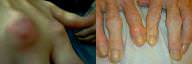 Osteoarthritis
  Gout
Gout  Type I
  Back Pain
  Cancer
Comments: Osteoarthritis vs Rheumatoid Arthritis
Anonymous comments (2)